Here’s a quick review of papers published in the lab over the last six months.
First, graduate student Yuqi Liu published a paper in Cognition, examining whether congruence in separate frames of reference contribute differently in multisensory integration. Using the mirror box, Yuqi had participants make synchronous or asynchronous tapping movements in the same or opposing postures, manipulating whether the movements were congruent or incongruent in an external frame of reference (i.e. movements going in the same direction) or a motor-based frame of reference (i.e. coordinated flexion/extension). She found increased illusory shift and more ownership of the mirror hand when movements were externally vs. motorically congruent, providing evidence that information re: crossmodal congruency is represented in different frames of reference. For more, see this Twitter thread.
Second, we’ve published two TMS papers with our collaborators at Penn. In a paper with Priyanka Shah-Basak published in Neuropsychologia, we presented participants with a task where participants had to judge whether a line was bisected centrally, or to the left/right of the line center. Importantly, these lines were presented centrally, or to the left/right of the viewer to separate the effects of TMS on viewer-centered or stimulus-centered processes. We found that TMS of right superior temporal gyrus (STG) disrupted performance resulting in additional errors in which participants reported that the right side of the line was longer (i.e. “neglecting” the left side of the line). Importantly, this was observed regardless of line position relative to the subject, suggesting that STG plays a role in stimulus-centered, but not viewer-centered processing.
In a separate TMS study with Elisabetta Ambron published in the Journal of Cognitive Neuroscience, we found that visual magnification of the hand influences motor evoked potentials using TMS. When seeing the hand magnified, we found larger MEPs for the magnified hand (but not the opposite, not magnified hand), and that more areas of motor cortex were active as a function of TMS stimulation.
Finally, in work with our collaborators at the University of Nevada-Reno, we published a review paper in Consciousness and Cognition on object shape and motion processing in human dorsal cortex.
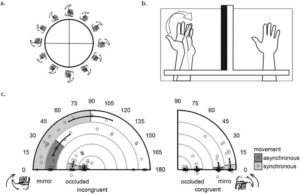 Our paper with Yuqi Liu (graduate student) is out in
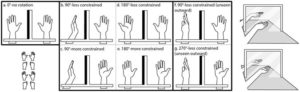 We then examined whether biomechanical constraints of the “body schema” (i.e. how can the arm realistically rotate) influenced the strength of the illusion. For example, place your hands as in Figure d. below. Rotating your left hand to match the position of the right hand is relatively easy. Now do the same movement using the starting position in Figure e. Note how the movement is more constrained at the end – this is due to biomechanical constraints that limit our movement. We found that participants showed a stronger illusion for less constrained movements vs. more constrained movements – a surprising result given that there was no