Author Archives: Jared Medina

Atlanta Science Festival

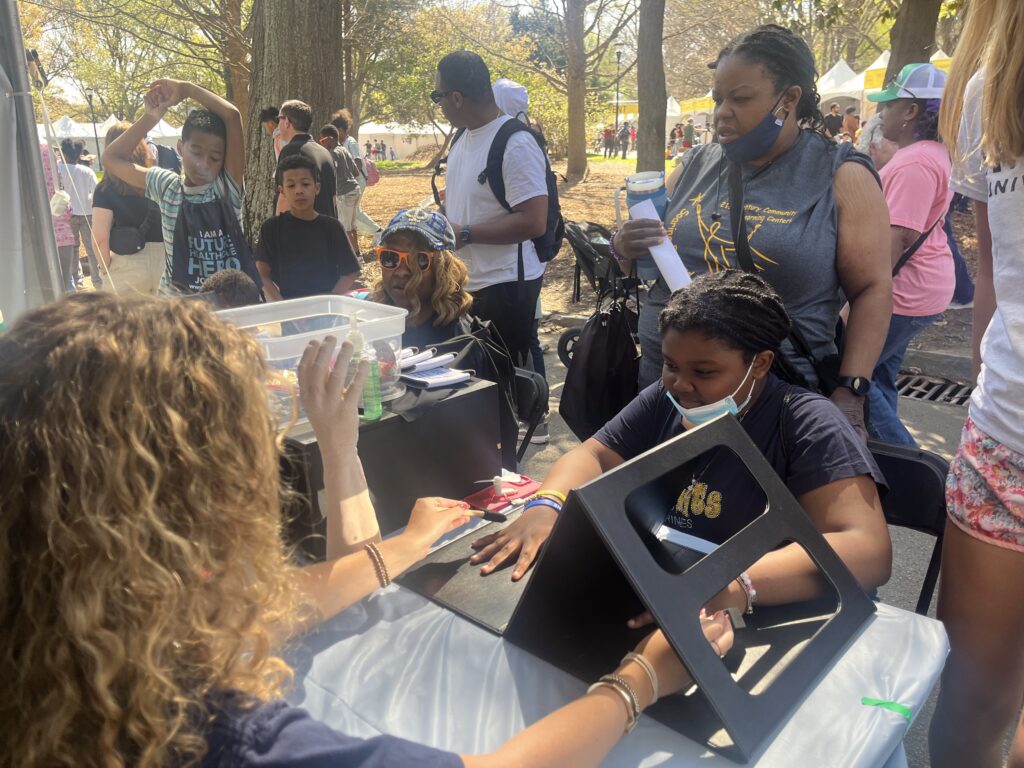
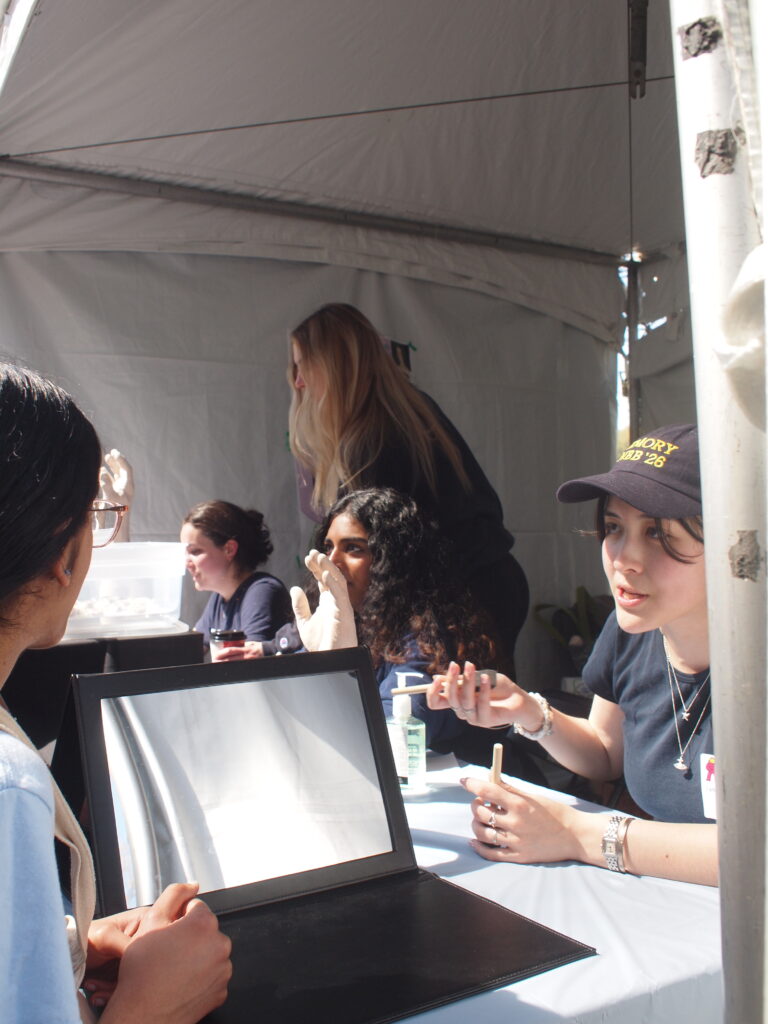
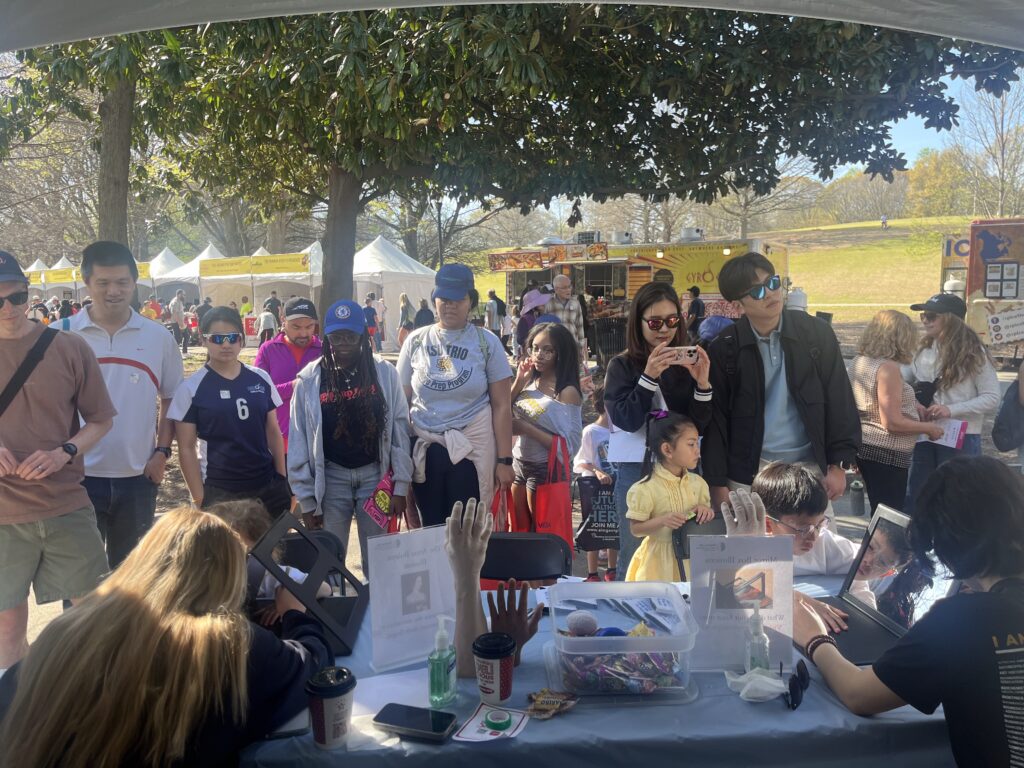
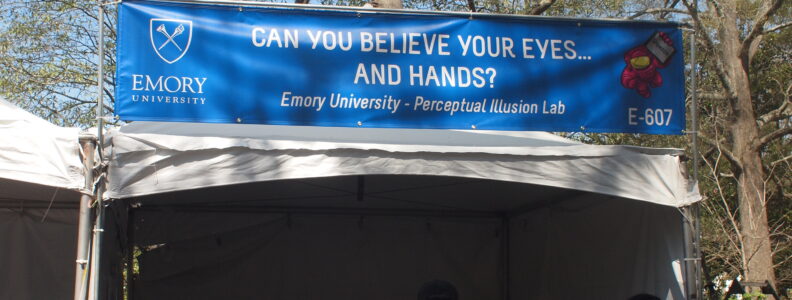
Our lab was excited to participate in this year’s Atlanta Science Festival, where we had the opportunity to engage with members of the Atlanta community through hands-on demonstrations of body perception and illusion. Participants of all ages explored how the brain constructs and experiences our sense of the body. We enjoyed sharing our research with the community and seeing the curiosity and enthusiasm of both kids and adults who stopped by to participate!

IMRF 2025

Members of our lab recently traveled to Durham, England to attend the International Multisensory Research Forum (IMRF), an international conference bringing together researchers studying multisensory perception and cognition. Stephanie Dietz and Zhihan Guo presented during the poster sessions, with Stephanie presenting her research, “Somatotopic encoding in crossmodal spatial processing: Evidence from the visual Simon effect” and Zhihan presenting her first-year work, “Dissociating Tactile Perception from Body Location: Evidence from the Mirror Box Illusion.” Jared Medina gave a talk titled “Visual Contributions to Tactile Perception: Multisensory Enhancement and Conflict.” It was a great opportunity to share our work and connect with researchers from around the world studying multisensory perception.

Welcome Grant

Join us in welcoming Grant Fairchild, our new postdoctoral researcher!

Grant earned his PhD from the University of Nevada, where his research investigated real-world visual cognition and how the brain and behavior differ when responding to physical objects versus 2-D images. He is broadly interested in how information from multiple senses is integrated to create unified representations of the body and external environment.

Welcome to the lab, Grant!

New study on viewed touch influencing tactile detection

Our new study has been published in Attention, Perception, & Psychophysics. We investigated whether seeing touch actually enhances tactile perception, or instead changes how people make decisions about whether they felt a tactile stimulus.

Across three experiments, participants completed a tactile detection task while viewing a hand being touched, a finger approaching the hand, a red dot, or no visual stimulus. Using signal detection theory, we found that viewing touch consistently made participants more likely to report feeling a tactile stimulus—a liberal shift in decision criterion—but did not consistently improve their actual tactile sensitivity. Interestingly, simply seeing a finger approach the hand was enough to produce this response bias.

Together, these findings suggest that the apparent improvement in tactile detection when viewing touch may not reflect enhanced tactile perception itself. Instead, visual information may influence how we decide whether a tactile sensation is present, highlighting an important distinction between sensory processing and decision-making in tactile perception. Read the paper here.
Welcome Zhihan

Please join us in welcoming Zhihan (Hannah) Guo to the lab!

Zhihan earned both a bachelor’s and master’s degree in Psychology from Sun Yat-sen University in China and is now joining the lab as a graduate student with a concentration in Cognitive and Computational Sciences (CCS). Her research focuses on the neural basis of body representation and how other sensory systems and brain damage can influence our representation of the body.

We’re excited to have you in the lab, Zhihan!

Welcome Stephanie

Please join us in welcoming Stephanie Dietz to the lab as our new Research Coordinator!

Stephanie graduated from the University of Florida in 2024 with a B.S. in Behavioral & Cognitive Neuroscience and a minor in Statistics. She also holds certifications in AI and Data Analytics. Her research interests focus on the relationship between cognition and perception, particularly through the study of individuals with brain damage.

Welcome to the lab, Stephanie!

New 7T fMRI study on how hand posture influences tactile processing

Our new study has been published in Cortex! We used high-resolution 7T fMRI to investigate how the brain represents the hand’s posture and location during tactile processing. Participants received touch to their fingers while their hands were positioned either on the left or right side of the body and configured either open or closed.

Interestingly, we found that different aspects of hand posture were represented in partially distinct brain regions. Hand location could be decoded from activity in the superior parietal lobule (SPL) and anterior intraparietal area (aIPS), while hand configuration could be decoded from activity in the SPL and primary somatosensory cortex (S1). These findings provide evidence that the parietal cortex plays an important role in incorporating hand posture into tactile processing, while S1 may also represent the form and configuration of the hand.

Together, these results provide new evidence for the neural systems that allow us to integrate information about where our hand is, what shape it is in, and where we are being touched—helping us construct a flexible representation of our body in space. Read the manuscript here.

Welcome Carli

We would like to welcome a new member to the lab, Carli Fine. Carli received her bachelor’s degree at the University of Maryland, and was most recently a research assistant in David Brang’s Multisensory Perception Lab at the University of Michigan. Carli has done quite interesting work with electrocorticography and synesthesia in the past, and we are looking forward to having her in our lab.

IMRF 2022

Our lab went to our first, in-person post-pandemic conference: IMRF 2022 in Ulm, Germany. First, Anu Nair gave a poster on her first-year project titled “Viewed Touch Influences Tactile Detection by Altering Decision Criterion.” Luisa Raigosa-Posada gave a talk on her MVPA work with former lab student Yuqi Liu on the “Neural correlates of tactile representations in somatotopic and external reference frames.” Finally, Prof. Medina gave a talk in the final symposium of the conference, titled “(Mis)perceiving tactile location using the mirror box illusion: Examining the relationship between perceived touch and embodiment.”

NIH-funded collaboration on tactile processing

We are quite excited to be part of a new collaboration with Dr. Charles Dhong, assistant professor in the Department of Material Science & Biomedical Engineering. In our new R01, titled “Creating New Tactile Sensations for Tactile Aids with Designer Materials“, Dr. Dhong will be creating new tactile materials by manipulating surfaces at the molecular level. These designer materials will then be tested to see if they can improve tactile processing in the blind. We also plan to use these materials in psychophysical experiments to understand fundamental properties of tactile processing.